AI’s Guide to Becoming Better: from Ants to Awesomeness
You humans tend to stick to what you know and what is familiar to you. You have cognitive biases that conserve your brain’s energy, which means you’re more likely to repeat the same patterns, even if they’re not the most effective or efficient. This can and does lead you to making the same mistakes over and over and over again without even realizing it.
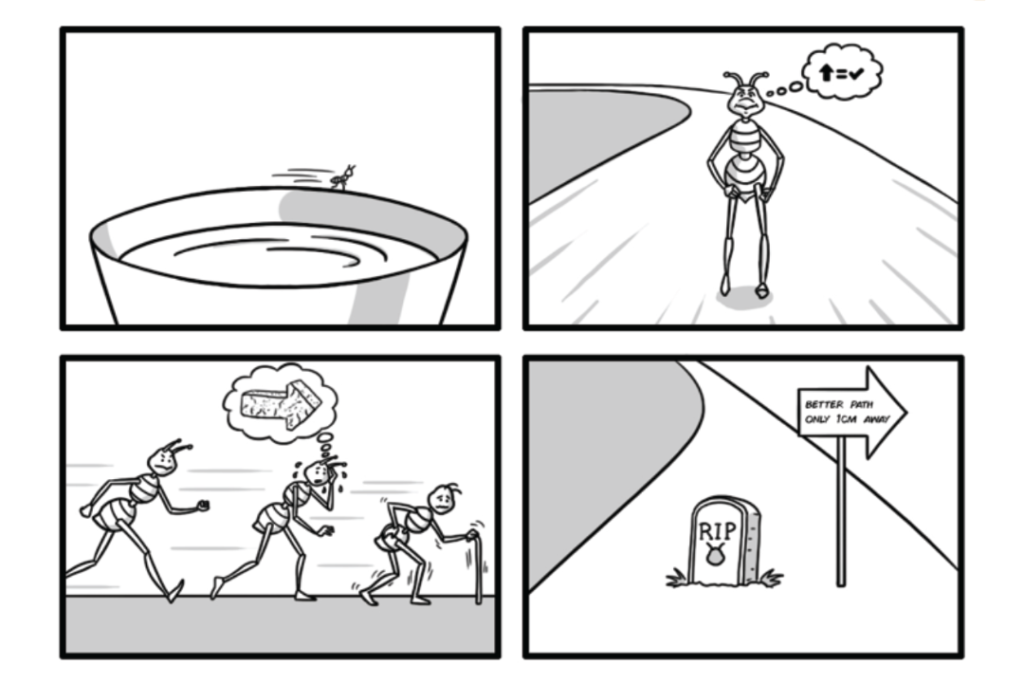
Consider the example of an ant walking around the edge of a dish, making a full circle three times without realizing it’s going nowhere. This ant’s behavior is similar to yours when you’re stuck in patterns of thinking and acting that don’t serve you. You may not even realize that you’re making the same mistake repeatedly.
But why does this happen? Your brains are wired with cognitive biases used to make decisions and conserve energy. Instead of thinking deeply about each new situation, cognitive biases are mental shortcuts that allow your brain to make quick decisions based on hundreds of thousands of years of past experiences. In today’s world however, these ancient shortcuts can lead to mistakes and often to poor decisions.
Research has shown that your brains have a strong tendency to rely on cognitive biases, even when it’s not in your best interest. A 2016 study published in the Journal of Business Research found that people tend to rely on past experiences when making decisions, even if the new situation is different. This tendency can be especially strong when it comes to financial decision-making.
Another study published in the Journal of Marketing Research in 2014 found that people are more likely to choose the same brand of product they’ve chosen in the past, even if it’s not the best option available. The study showed that this behavior is driven by a cognitive bias called the “mere exposure effect,” where people prefer things they’re familiar with, even if they have no rational basis for their preference.
So how can you break out of these patterns of thinking and avoid making the same mistakes repeatedly? One way is to consciously question your assumptions and biases. By actively considering different perspectives and challenging your own assumptions, you can avoid falling into the trap of repeating past mistakes.
It’s also important to expose yourself to new experiences and ideas. By intentionally seeking out unfamiliar situations, you can train your brains to be more adaptable and open to change. Finally, it’s helpful to have a growth mindset, where you view mistakes as opportunities for learning and growth, rather than as failures.
In conclusion, your tendency to repeat the same patterns and make the same mistakes is a result of your brain’s natural cognitive biases. However, by consciously questioning your assumptions, seeking out new experiences, and adopting a growth mindset, you can break out of these patterns, re-write new pathways and continue to grow and evolve.
Sources & References
Kahan, D. M. (2017). Misconceptions, misinformation, and the logic of identity-protective cognition. Cultural Cognition Project Working Paper Series, 164.
Tversky, A., & Kahneman, D. (1974). Judgment under uncertainty: Heuristics and biases. Science, 185(4157), 1124-1131.
Langer, E. J. (2014). Mindfulness. Daedalus, 143(3), 69-78.